How to Evaluate Tech Company Culture and Total Rewards Before You Join
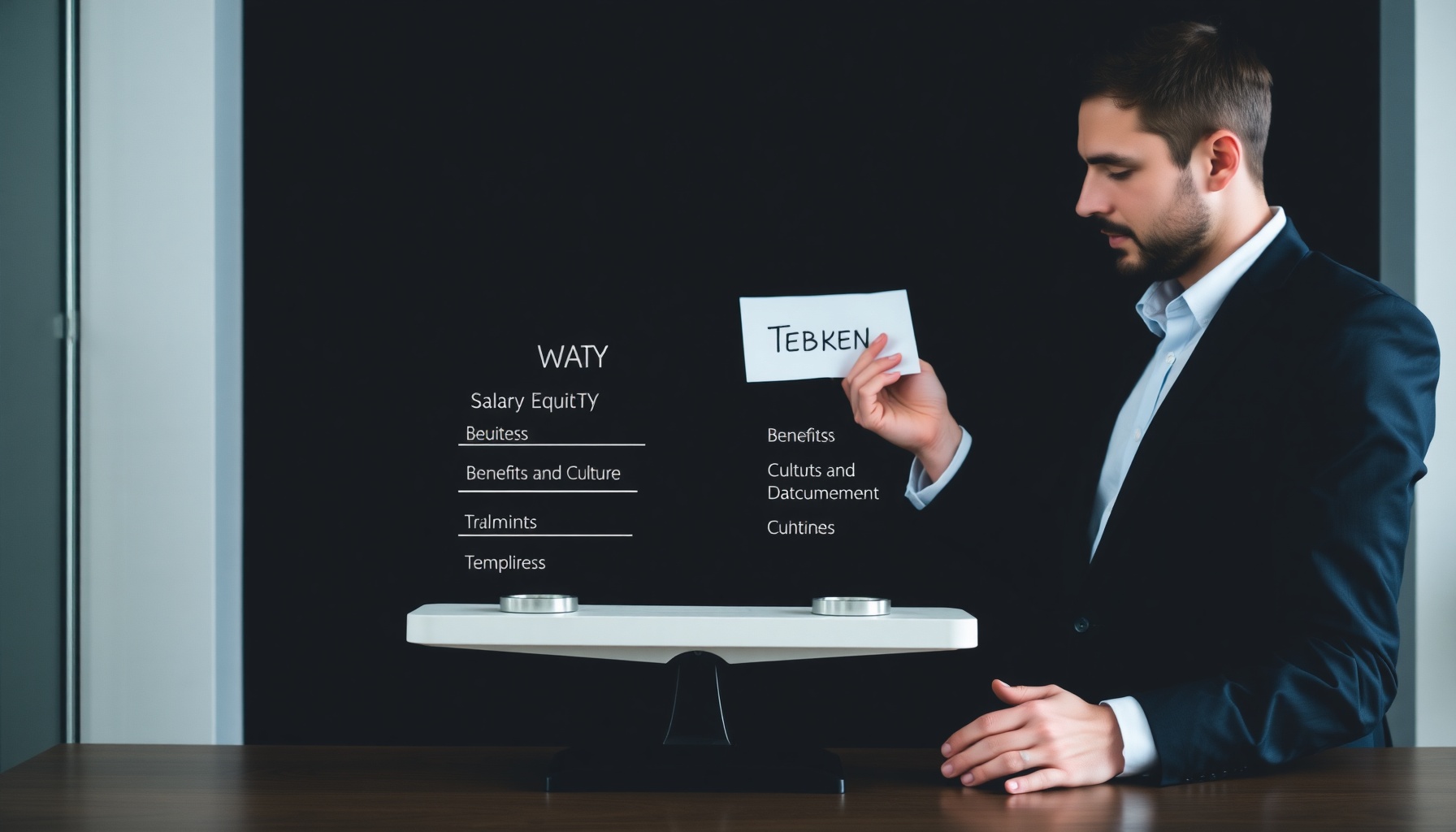
You’ve passed the interviews. An offer is coming. Now comes the hard part: deciding whether to say yes.
Most tech professionals focus almost exclusively on base salary when evaluating offers. That’s a mistake — salary is just one component of your total rewards package, and compensation alone tells you almost nothing about whether you’ll be happy, productive, and growing a year from now.
In 2026, the landscape of tech compensation and culture is more complex than ever. Remote-first vs. return-to-office, RSU-heavy vs. cash-heavy comp, startup equity vs. FAANG stability — each choice is a trade-off. Here’s a systematic framework to evaluate both culture and total rewards before you sign.
What total rewards actually means
Total rewards goes far beyond your base salary. It includes five distinct categories:
| Category | What It Includes |
|---|---|
| Direct cash | Base salary, performance bonus, signing bonus |
| Equity | RSUs, stock options, ESPP (employee stock purchase plan) |
| Benefits | Health insurance, 401(k) match, disability, parental leave |
| Culture | Work-life balance, management quality, mission alignment |
| Growth | Learning budget, mentorship, promotion velocity, project quality |
A senior engineer at a FANG-tier company in 2026 might see a total comp of $400K–$650K, with only 40–50% of that as base salary Levels.fyi. The rest is RSUs and bonus. At a Series B startup, you might see a $180K salary with options worth potentially several million — or nothing at all. Evaluating these packages requires comparing apples to apples.
How to decode a compensation package
Understand the equity component
RSUs (Restricted Stock Units) and stock options behave very differently.
RSUs are straightforward: the company grants you shares that vest over time (typically 4 years with a 1-year cliff). At public companies, they have real dollar value you can calculate on the spot. Key questions to ask:
- What’s the vesting schedule? (4-year standard, but some companies now offer 3-year or even immediate vesting)
- Is there accelerated vesting in an acquisition? (single-trigger vs. double-trigger)
- What’s the company’s stock trajectory? For public companies, check their 3-year trend. For private companies, ask about the 409A valuation history and the latest primary round pricing.
Stock options are different. They give you the right to buy shares at a fixed price (the strike price). The potential upside is larger, but so is the risk. In 2026, with many late-stage startups staying private longer, the typical window to exercise after leaving has become a critical factor — some companies now offer 10-year exercise windows, which is significantly more employee-friendly than the traditional 90-day window.
What to ask about equity
In an offer call, you should absolutely ask:
- “What percentage of shares are currently outstanding as dilution? Has the company issued any new pools recently?”
- “How many shares would this grant represent as a percentage of fully diluted shares?”
- “For private companies: what was the last 409A valuation and when?”
- “What’s the exercise window after termination?”
If the recruiter can’t or won’t answer these, that’s itself a signal.
Evaluating culture: what actually matters
Compensation gets you in the door. Culture determines whether you stay — and whether you grow. But “culture” is vague. Here’s what to look for specifically.
Management quality is the #1 predictor
The single strongest predictor of job satisfaction is your direct manager. Gallup’s decades of research consistently show that managers account for at least 70% of the variance in employee engagement Gallup State of the Global Workplace 2025.
During interviews, pay close attention to:
- How the interviewer describes their team. Do they talk about individual contributions or collective outcomes? Do they mention their manager’s coaching style or just list project names?
- Turnover on the team. A high annual churn rate on a team of 8 is a crisis. Ask your recruiter for team tenure averages.
- How decisions are made. Do you sense consensus-by-default, clarity-by-leadership, or chaos-by-politics?
Glassdoor and Blind reviews can help, but take them with a grain of salt — people who post are disproportionately angry or ecstatic. A 3.8–4.2 Glassdoor rating with lots of reviews is actually a healthier signal than a perfect 5.0.
Work-life balance: beyond the slogans
In 2026, remote vs. in-office is the single most contentious culture issue in tech. The data tells a nuanced story:
- Fully remote workers report higher job satisfaction but slower promotion velocity (15–23% slower Stanford WFH Research 2025)
- Hybrid companies (3 days in-office) have the highest attrition — employees feel the worst of both worlds
- Companies with clear, written remote policies outperform those with ambiguous ones by every measure
When you evaluate culture, ask specific questions: “What’s the actual expectation for my specific team? Not the company policy — what does my manager expect?” The gap between official policy and team reality is where disappointment lives.
Career growth: the hidden tax of bad culture
The fastest-growing tech skills in 2026 — AI/ML engineering, platform engineering, developer experience — compound quickly when you’re surrounded by strong peers. A bad culture doesn’t just make you unhappy; it slows your career trajectory by reducing your learning velocity.
Look for:
- Internal mobility data. What percentage of roles are filled internally vs. externally? High internal mobility is a strong signal of a development-focused culture.
- Project allocation. Do junior engineers get greenfield projects or only maintenance work? How does the team decide who builds what?
- Learning budgets. The best tech companies in 2026 allocate $5K–$15K/year per engineer for conferences, courses, and tools O’Reilly Media 2025 Tech Salary Report.
Real examples: comparing offers side by side
Offer A: Large Public Company (Market Cap > $200B)
| Component | Value |
|---|---|
| Base salary | $220,000 |
| Annual bonus (target 15%) | $33,000 |
| RSU grant (4-year, 1yr cliff) | $400,000 ($100K/yr) |
| 401(k) match | 6% of salary |
| Total Year 1 value | ~$366,000 |
| Total On-Target Comp | ~$353,000/year |
Culture signals: 4.2 Glassdoor, WLB scores mid-range, known for strong internal mobility, but recent RTO mandate (3 days/week) caused friction.
Offer B: Series C Startup ($2B valuation)
| Component | Value |
|---|---|
| Base salary | $185,000 |
| Annual bonus (target 10%) | $18,500 |
| Option grant (4-year) | 40,000 options at $12.50 strike |
| Current FMV (409A) | $18.00/share |
| No 401(k) match | $0 |
| Total Year 1 value | ~$203,500 |
| Potential upside (at $30/share) | Additional $700K vested over 4 years |
Culture signals: 4.5 Glassdoor, fully remote, mission-driven team, but only 18 months of runway and no clear path to liquidity.
Making the call
Offer A has 1.7x the guaranteed Year 1 comp. But Offer B might be right if you value autonomy, remote work, and believe the company will 3x in value. Neither is universally better — the right answer depends on your risk tolerance, life stage, and career goals.
Red flags to watch for
Some culture issues are fixable. Others aren’t. Walk away from any company that shows these signs:
- Equity confusion. If no one can clearly explain the equity package, either it’s bad or they don’t want you to understand it.
- “We work hard and play hard.” This usually means the company expects 60-hour weeks and pays for beer to make up for it.
- Recent mass layoffs without clear strategic rationale. A responsible layoff comes with a clear thesis. Random cuts signal broken decision-making.
- Manager dodges questions. If your prospective manager won’t answer “What does a typical week look like?” or “What’s your management style?”, assume the worst.
- No structured onboarding. Companies with good culture invest in ramping new hires. If there’s no onboarding plan, you’ll be figuring everything out yourself.
The negotiation leverage you didn’t know you had
Your strongest negotiation position is between the offer and your acceptance. Use it wisely.
In 2026, the most effective negotiation strategies for tech professionals are:
- Get competing offers. Every study of tech compensation shows that competing offers are the single strongest lever for increasing total comp — by 10–30% on average Haseeb Qureshi negotiation data.
- Negotiate equity, not just salary. Companies have more flexibility on equity grants than base salary. A meaningful increase in RSUs costs the company less cash and provides more upside for you.
- Ask for a signing bonus to smooth the transition if you’re leaving unvested equity at your current company. This is standard practice at top tech employers.
- Negotiate the start date. This sounds minor, but it affects your first-year prorated bonus targets, vesting schedules, and 401(k) match eligibility.
Tools and resources
Use these resources to evaluate offers thoroughly:
| Tool | What It Does |
|---|---|
| Levels.fyi | Salary, equity, and compensation band data by company, level, and location |
| Glassdoor | Employee reviews, culture ratings, and interview insights |
| Blind | Anonymous peer discussions with verified employee badges |
| Comp Sheets | Compensation benchmarking specifically for startups |
| Option Strategist | Startup equity value calculator (illiquidity-adjusted) |
| O’Reilly Tech Salary Survey | Annual tech compensation and skills trends report |
The bottom line
Evaluating a tech company’s culture and rewards isn’t about finding the highest salary. It’s about finding the best risk-adjusted, values-aligned package for your specific situation.
Build a framework: score each offer across the five categories (cash, equity, benefits, culture, growth). Weight them by what matters most to you right now. A 33-year-old senior engineer with a newborn will weight benefits and WLB differently than a 27-year-old who wants to maximize career velocity.
And remember: the best negotiators aren’t the ones who ask for more money. They’re the ones who know what they actually want — and recognize a good fit when they see it.
Data sources: Levels.fyi Total Compensation Report 2025–2026, Gallup State of the Global Workplace 2025, Stanford/WFH Research Remote Work Impact Study 2025, O’Reilly Media 2025 Tech Salary Survey, Haseeb Qureshi Negotiation Data (2025 update), Glassdoor Culture Ratings 2026.
References
[1] Levels.fyi [2] Gallup State of the Global Workplace 2025 [3] Stanford WFH Research 2025 [4] O’Reilly Media 2025 Tech Salary Report [5] Haseeb Qureshi negotiation data [6] Glassdoor
← Back to all posts