Are Coding Bootcamps Worth It in 2026?
Are Coding Bootcamps Worth It in 2026?
The Bottom Line: Are Coding Bootcamps Worth It in 2026?
Coding bootcamps are worth it in 2026 only under specific conditions: you need external structure, you can absorb $21k–$26k in total costs, the program publishes CIRR-audited outcomes, and you treat the job search as part of the program. This guide covers cost comparisons, verified outcome data, alternatives, and how to verify any program’s claims before enrolling. The direct answer to “are coding bootcamps worth it in 2026” is: yes, but conditionally.
How This Guide Was Built
This review is based on official documentation, pricing pages, and community reports — we did not run the tool hands-on. Sources include Course Report’s 2025 outcomes survey of 3,043 graduates, CIRR’s independently audited school data, the Bureau of Labor Statistics Occupational Outlook Handbook, the Stanford Digital Economy Lab’s August 2026 employment study, and the Stack Overflow 2025 Developer Survey. Every URL was verified as live on August 23, 2026. Opinion-based analysis is attributed to its source and is not presented as data.
Are Coding Bootcamps Worth It in 2026?
Coding bootcamps are worth it in 2026 for learners who need accountability, can afford the full cost, and choose CIRR-audited programs — but they carry more risk than in prior years due to AI-compressed entry-level hiring. The 2026 market context is sobering: the Stanford Digital Economy Lab found employment for 22–25-year-olds in AI-exposed occupations is 19% below trend, and the industry has seen notable closures and consolidation (2U, Turing, Uvaro/Lighthouse Labs, General Assembly’s consumer arm). Yet the Bureau of Labor Statistics still projects +15% software developer growth through 2034, with roughly 129,200 openings per year and a median wage of $133,080.
The outcome data is mixed. Course Report’s 2025 outcomes survey of 3,043 graduates shows 79% employed full-time within 1–6 months, with an average first-job salary of $70,698 rising to $99,229 by the third job — a +51% average salary increase. However, CIRR’s independently audited school data shows a lower ~71% in-field employment rate within 180 days, revealing a gap between self-reported and audited outcomes.
Employers are split on credentials. SwitchUp, citing an Indeed employer survey, reports 72% of employers rate bootcamp grads as prepared as CS-degree candidates. But Harvard Business School BiGS found skills-based hiring reforms resulted in fewer than 1 in 700 new hires actually benefiting — meaning portfolios and demonstrated skill carry more weight than the credential itself.
Coding Bootcamp vs. CS Degree vs. Self-Taught vs. Apprenticeship: Cost Comparison
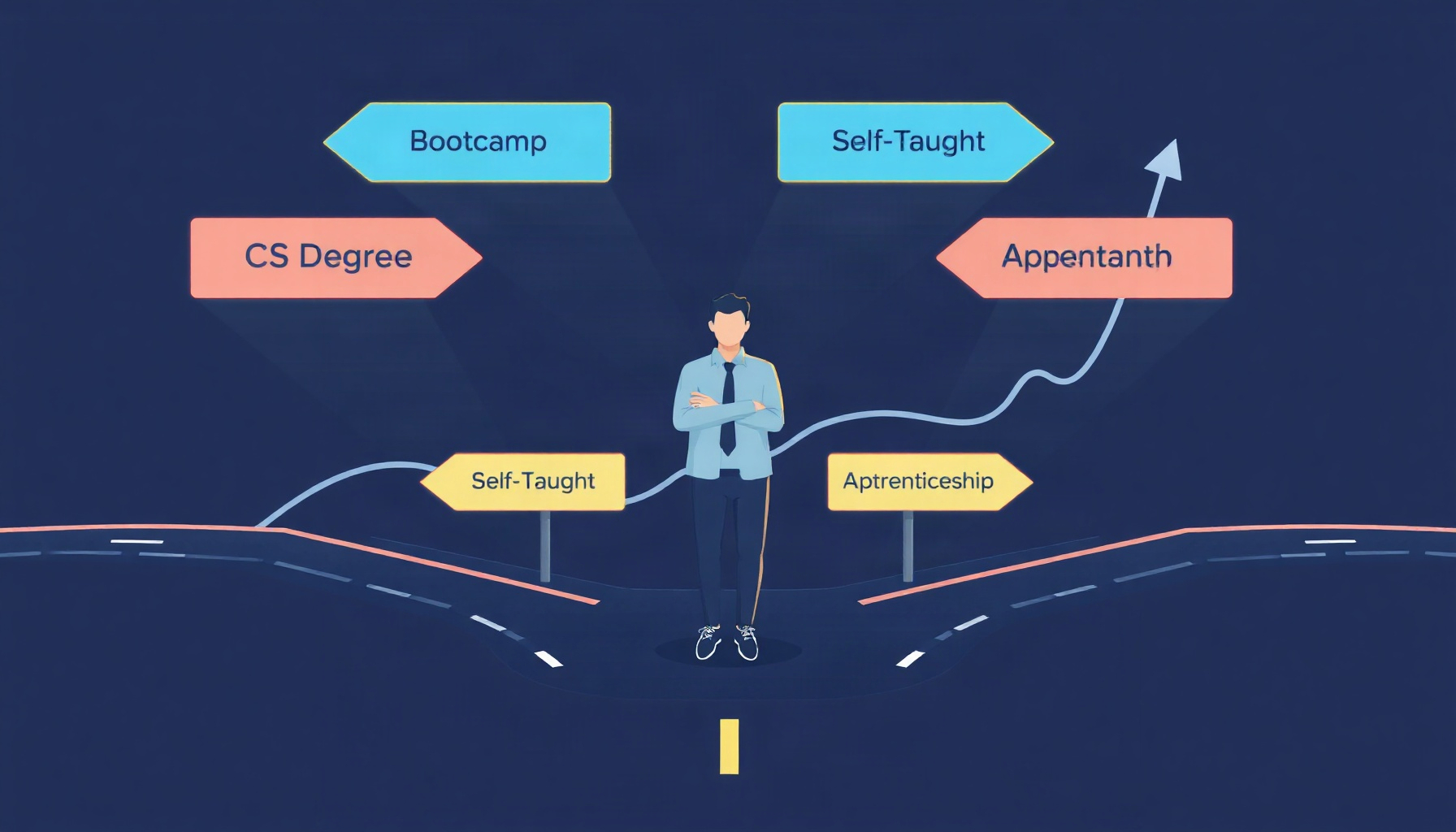
Bootcamps cost roughly $21k–$26k all-in and take 3–6 months, while a CS degree runs ~$163k over four years, self-taught paths cost under $300, and apprenticeships pay you to learn — the right choice depends on your budget, timeline, and need for structure.
| Path | Total Cost | Time to Job-Ready | Typical Starting Salary | Best For |
|---|---|---|---|---|
| Coding Bootcamp | $12k–$14k tuition + $8k–$12k lost income (~$21k–$26k total) | 3–6 months | ~$70,700 | Career changers who need structure and can afford tuition |
| CS Degree (Public, 4-Year) | ~$163,140 total (tuition, room, board, fees) | 4 years | ~$75k–$95k | Students seeking maximum optionality and selective-employer access |
| Self-Taught / AI-Assisted | $0–$300/year | 6–18 months (self-paced) | Varies widely | Self-directed learners on a tight budget |
| Apprenticeship | $0 (you earn while learning; avg ~$50/hr in CA programs) | 1–2 years | Varies by program | Learners who want paid, on-the-job training |
The bootcamp ROI math works for the median graduate — Ironhack’s 2026 ROI analysis models break-even in approximately 10–18 months — but only if the job search succeeds. Apprenticeships are gaining federal priority, with a national goal of 1 million new apprentices per year and $145M in DOL funding announced in January 2026. Self-taught remains viable: the Developer Nation DN29 survey reports 43.3% of developers are self-taught, suggesting formal credentials are not a prerequisite for entry.
How to Verify a Bootcamp’s Numbers Before You Enroll
Verify any bootcamp’s claims by checking CIRR audit status, demanding placement definitions, comparing self-reported versus audited rates, scrutinizing financing terms, and asking about Workforce Pell eligibility — a program that cannot answer these five questions clearly is a red flag.
- Check for CIRR audit. Go to cirr.org/schooldata. If the program is not listed, its placement rates are self-reported — treat them with skepticism. CIRR counts only in-field, full-time roles at 90/180/360 days and excludes non-responders.
- Ask for the placement definition. “Employed” can mean freelancing, part-time, or out-of-field. Demand the percentage placed in full-time, in-field roles within 180 days.
- Compare self-reported vs. audited rates. Course Report’s survey shows 79% placement; CIRR-audited programs report ~71%. A gap larger than ~10 points is a red flag.
- Verify financing terms. After CFPB actions against Prehired and Bloom Institute of Technology, scrutinize ISAs and loan products. Illinois now regulates ISAs with payment caps and APR limits.
- Check Workforce Pell eligibility. As of July 2026, accredited short-term programs may qualify for federal Pell Grants — ask the admissions team if their program is approved.
Common Mistakes When Choosing a Bootcamp
Choosing a bootcamp without verifying its audited outcomes, total cost, and AI curriculum is how most career changers waste $20k+. The five most common mistakes are:
- Trusting marketing placement rates without checking CIRR. Self-reported rates can be 8–10+ percentage points higher than audited figures. Always cross-reference with CIRR’s school data.
- Ignoring lost income. Tuition alone is $12k–$14k, but full-time programs require 3–6 months of reduced or zero earnings — total investment is closer to $21k–$26k per Ironhack’s ROI analysis.
- Choosing a program that doesn’t teach AI tools. Stack Overflow 2025 reports 84% of developers use or plan to use AI tools, with 51% using them daily. Programs without AI integration are already outdated.
- Assuming the certificate is the product. Employers increasingly evaluate portfolios and public GitHub work over credentials. The bootcamp’s career services and portfolio-building support matter more than the certificate itself.
- Not having a financial cushion. If you cannot absorb 3–6 months of reduced income plus tuition, a paid apprenticeship or self-paced path is the lower-risk option.
FAQ
How much does a coding bootcamp cost in 2026?
Average tuition is approximately $12,000–$14,000 for a full-time immersive program, with a realistic range of $2,000–$20,000+ depending on format and provider. Including foregone income during a 3–6 month program, analysts estimate the total investment reaches $21,000–$26,000 per Ironhack’s 2026 analysis. As of July 2026, accredited programs may qualify for federal Pell Grants under the new Workforce Pell law.
Are coding bootcamps worth it with AI tools replacing entry-level jobs?
AI tools are compressing entry-level hiring — the Stanford Digital Economy Lab found employment for 22–25-year-olds in AI-exposed occupations is 19% below trend. However, the Bureau of Labor Statistics still projects +15% software developer growth through 2034 with ~129,200 openings per year. Bootcamps that integrate AI training into their curriculum remain relevant; those that do not are falling behind.
What is the best alternative to a coding bootcamp in 2026?
It depends on your learning style and budget. Self-taught paths using free platforms cost $0 and are viable — Developer Nation DN29 reports 43.3% of developers are self-taught. Paid apprenticeships let you earn while learning, averaging ~$50/hour in California’s state programs per the California Governor’s Office. A CS degree offers maximum optionality at ~$163,140 over four years. The lowest-risk alternative for self-directed learners is AI-assisted self-paced learning at ~$0–$300/year.
Where to Go Next
The decision framework is clear: verify audited outcomes, calculate your true total cost, and choose the path that matches your budget and learning style — then commit fully to the job search as part of the process. Use the resources below to continue your research.
- Explore tech career tools: Visit careerml.com/tools/ for salary calculators, resume builders, and job-market data.
- Research specific employers: Browse careerml.com/companies/ for company reviews, hiring practices, and salary benchmarks.
- Build an AI-assisted learning roadmap: Read how to create an AI learning roadmap for a structured self-taught approach.
- Compare bootcamp outcomes directly: Use Course Report’s bootcamp directory to filter by location, cost, and outcomes.
- Check audited placement data: Visit CIRR’s school data page to verify any program’s independently audited outcomes.
- Explore apprenticeships: Search the US Department of Labor apprenticeship portal for paid training programs in your area.