Online Master's Degrees for Tech: Worth It in 2026?
Online Master’s Degrees for Tech: Worth It in 2026?
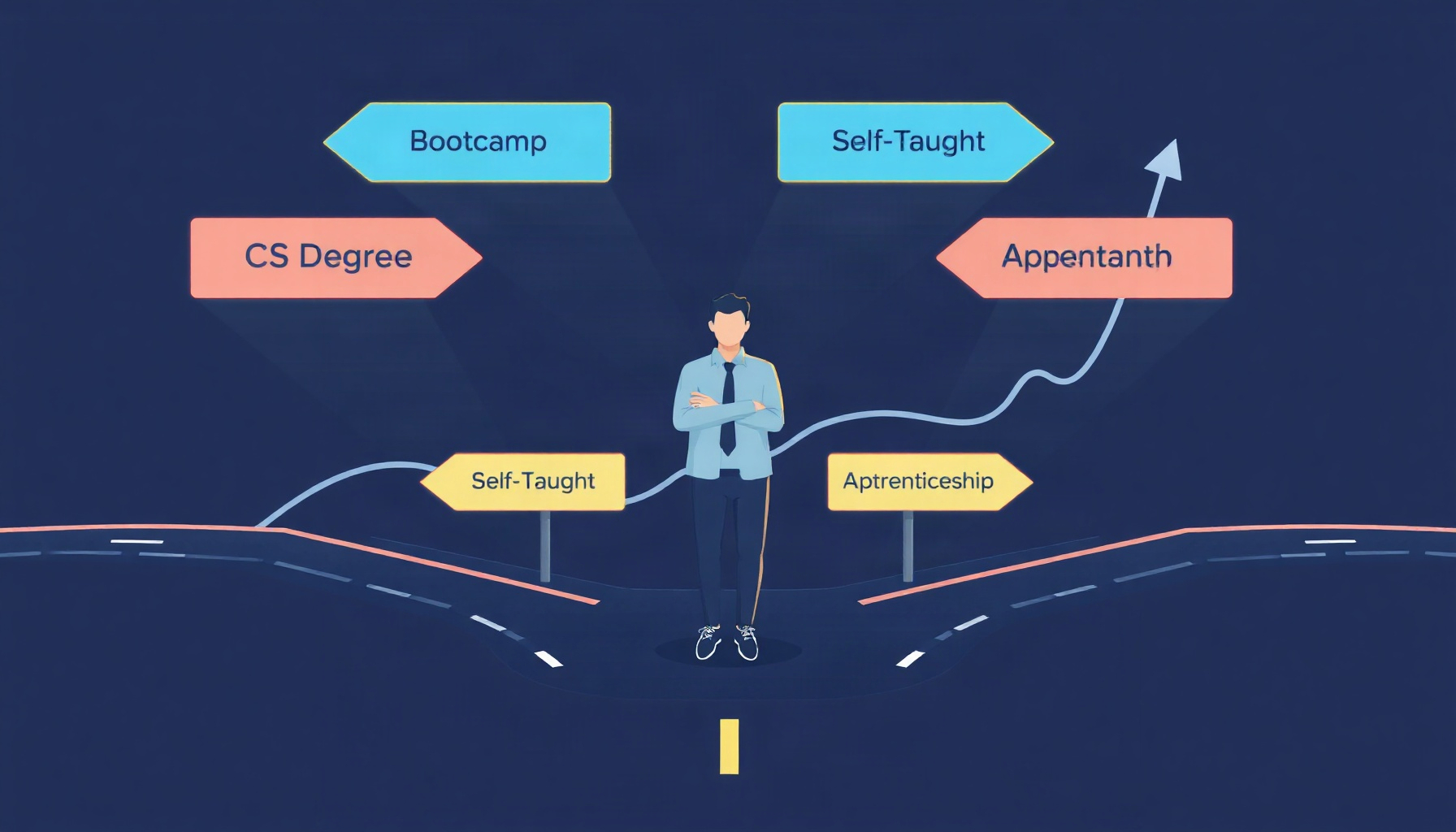
Are online master’s degrees worth it for tech professionals in 2026? For a mid-career engineer with employer tuition reimbursement targeting fundamentals-heavy roles — ML engineering, systems architecture — the answer leans yes: flagship online programs from Georgia Tech, UT Austin, UIUC, and CU Boulder cost under $26,000 total. For a fast pivot into hands-on development, the 2-4 year evening commitment usually loses to a bootcamp or certification. The market splits the same way: 53% of employers have eliminated degree requirements, up from 30% the prior year, per the TestGorilla 2025 report, yet 41% of employers say degrees are more important than five years ago per the same research. The degree’s value now sits in structured fundamentals and network — cost and employer support decide whether it pays.
How This Guide Was Built
This guide is based on official program pages and tuition documents from Georgia Tech, UT Austin, UIUC, and CU Boulder, plus the TestGorilla State of Skills-Based Hiring 2025 report, the WEF Future of Jobs Report 2025, and Georgetown CEW research. We verified tuition costs, credit requirements, admission criteria, and degree prerequisites. We did not enroll in or take courses from any program — completion-time and outcome statements come from official program documentation. Last verified: September 2026.
Online Master’s Cost Comparison: GT vs. UT vs. UIUC vs. CU Boulder
Georgia Tech’s OMSCS totals $6,900–$7,440 for 30 credits per its Fall 2026 Bursar schedule, UT Austin’s MSCSO runs $10,000+ per CDSO, UIUC’s online MCS costs $19,840–$25,376 per Coursera, and CU Boulder’s MS-CS is $15,750 flat per CU Online — a $19,000 spread across four flagship programs.
| Program | Total cost | Credits | Time | Degree requirement |
|---|---|---|---|---|
| Georgia Tech OMSCS | $6,900–$7,440 | 30 | Up to 6 years | Bachelor’s mandatory; CS preferred |
| UT Austin MSCSO | $10,000+ | 30 | Not specified | Bachelor’s in related field |
| UIUC Online MCS | $19,840–$25,376 | 32 | 12–36 months | Bachelor’s mandatory |
| CU Boulder MS-CS | $15,750 | 30 | 8-week sessions | None (performance-based admission) |
Four details sit behind those numbers. Georgia Tech’s tuition runs $227–$248 per credit hour by residency plus a $212–$531 online fee each semester per the Bursar schedule. UIUC bills pay-as-you-go — $620 per credit for Illinois residents, $793 for non-residents — per the Siebel School. CU Boulder charges one flat rate regardless of residency per CU Online. Pace varies more than price: UIUC students typically finish in 12–36 months at 10–12 hours weekly per Coursera, while OMSCS stretches to six years asynchronously per Georgia Tech.
Admission bars differ too: GT requires a 3.0 GPA and a CS-adjacent bachelor’s, with no GRE, per OMSCS admission criteria; UT wants a 3.0+ upper-division GPA in a related field, also with no GRE, per CDSO; UIUC recommends a 3.2 GPA and requires no GRE or recommendation letters per the Siebel School; CU Boulder skips GPA cutoffs via performance-based admission per CU Online.
Are Online Master’s Degrees Worth It for Tech Professionals?
Yes for fundamentals-focused mid-career engineers with employer funding; no for fast pivots. Skills-based hiring now covers 85% of employers, up from 81%, per TestGorilla, yet master’s holders still earn a median $3.2M per career versus $2.8M for bachelor’s degrees, per Georgetown CEW — the premium persists, but hiring runs through demonstrated skills.
Four factors decide your side of that line.
(a) Employer reimbursement decides net cost. UT Austin explicitly encourages employer tuition assistance, per the CDSO application page, and Georgia Tech notes modest subsidies may cover OMSCS tuition in full per Georgia Tech OMSCS. A $6,900 net cost changes every ROI calculation.
(b) Career stage sets the return. Engineers with 5–8 years in ML/AI extract the most: distributed systems, ML theory, and algorithm depth compound into staff-plus scope. At 10+ years, fundamentals return less. Anchor coursework to a target role using our AI learning roadmap for 2026.
(c) Time is the real price. A bootcamp asks for three months; a master’s asks for 2–4 years of evenings. Price that honestly against your current trajectory.
(d) Degrees stay a tiebreaker for research-adjacent roles. Where postings prefer an MS — applied science, research engineering — the credential clears filters. But Georgetown CEW found one quarter of bachelor’s holders out-earn half of master’s holders: it is a lever, not a guarantee.
3 Common Mistakes When Considering an Online Master’s
The costliest mistakes are financial and structural: enrolling before checking employer reimbursement, picking a program for its name rather than its AI/ML curriculum, and misjudging a 2-4 year evening commitment in a market where the WEF Future of Jobs Report 2025 projects 39% of workers’ existing skills will be transformed or outdated by 2030.
-
Skipping the reimbursement conversation. Net cost, not sticker price, decides ROI. UT Austin explicitly encourages employer tuition assistance per the CDSO application page, and Georgia Tech says modest subsidies may cover OMSCS entirely per Georgia Tech OMSCS. One meeting with your manager can zero out the bill.
-
Choosing prestige over curriculum fit. A brand adds nothing if the catalog skips your target role’s core: ML systems, distributed computing, algorithms. Audit the credit structure — 30 credits at GT and UT, 32 at UIUC per Coursera — before paying for the logo.
-
Underestimating the evening math. OMSCS allows one course per semester for up to six years per Georgia Tech, but plan for 2–4 years of nights and weekends. With 39% of skills transforming by 2030 per the WEF, favor curricula built on fundamentals that age slowly.
Certifications, Bootcamps, or Self-Study?
Certifications and bootcamps win on speed and price; a master’s wins on structured depth. With 53% of employers having dropped degree requirements per TestGorilla, skills proof increasingly outranks credentials — which is why certifications, bootcamps, and self-study remain the faster path for hands-on development roles, while the degree anchors fundamentals for ML and architecture work.
Pick by target role, not status. Moving into hands-on development? Our which tech certifications are worth it in 2026 guide maps certifications to cloud, security, and data roles in months. Career changers who need proof they can ship should read our coding bootcamp analysis for 2026. Self-study suits disciplined generalists who know exactly which gap to close. What none of these replicate is the structured-fundamentals package: graded problem sets, a cohort, and a network — the actual product a master’s sells.
FAQ
These three questions decide most enrollment decisions: cost, prerequisites, and employer perception. Short version: master’s holders earn a median $3.2M per career versus $2.8M for bachelor’s per Georgetown CEW, non-CS backgrounds can enter through CU Boulder’s performance-based pathway per CU Online, and 85% of employers use skills-based hiring per TestGorilla.
How much does an online master’s in computer science cost in 2026?
An online master’s in computer science costs $6,900 to $25,376 total in 2026: Georgia Tech’s OMSCS runs $6,900–$7,440 per its Fall 2026 Bursar schedule, UT Austin’s MSCSO starts above $10,000 per CDSO, CU Boulder’s MS-CS totals $15,750 per CU Online, and UIUC’s online MCS reaches $25,376 for non-residents per Coursera.
Can I get a master’s in computer science without a CS bachelor’s degree?
Yes. CU Boulder’s MS-CS admits students without any bachelor’s through performance-based admission — pass three one-credit pathway courses with a B or better — per CU Online. UIUC accepts non-CS graduates who complete prerequisites per the Siebel School, and Georgia Tech prefers CS but accepts math, computer engineering, or electrical engineering degrees per OMSCS admission criteria.
Do tech employers value online master’s degrees the same as in-person?
A rigorous online master’s from a flagship university reads as a real credential: Georgia Tech’s OMSCS has graduated more than 10,000 alumni in its first decade per Georgia Tech, and 41% of employers say degrees are more important than five years ago per TestGorilla. Treat the credential as a tiebreaker backed by skills proof, not a gate-opener.
Your Next Step
Request admissions calls from two programs on the comparison list if your employer offers tuition reimbursement — the Georgetown CEW premium ($3.2M versus $2.8M median career earnings) compounds fastest when net cost stays low. If reimbursement isn’t on the table, start with a skills plan: our skills development blueprint for 2026 maps credentials to roles before you commit years of evenings.
← Back to all posts