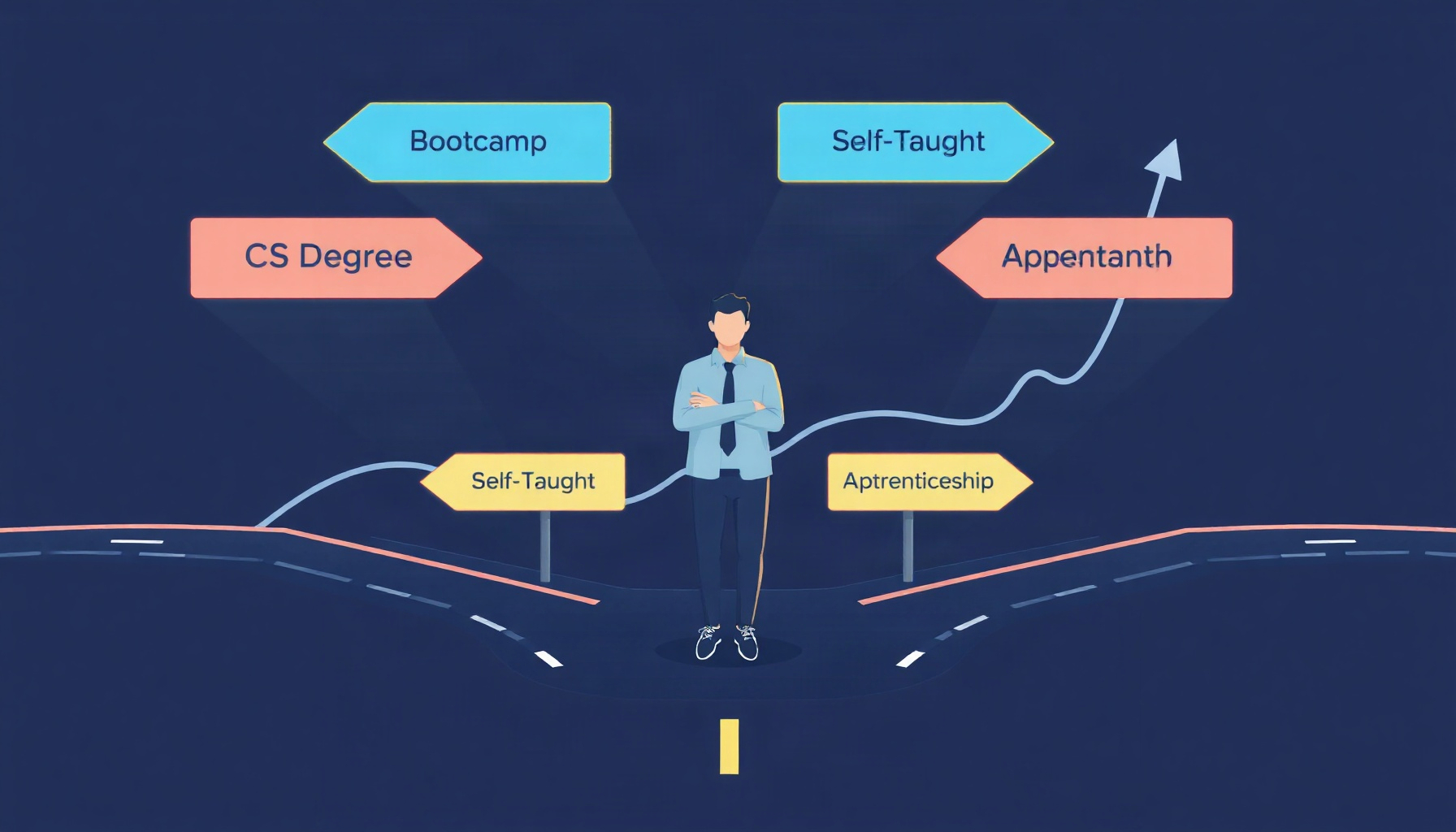
How to Get Into Tech Without a Degree in 2026

How to Get Into Tech Without a Degree in 2026
Wondering how to get into tech without a degree? In 2026 the honest answer is: yes, and you have more credible options than ever. This guide maps all five viable pathways — tech apprenticeships, accredited online degrees, coding bootcamps, self-taught routes, and micro-credentials — with verified costs, realistic timelines, and published outcome data from government statistics, university pricing pages, and employer programs. No hype, no cheerleading for one route over another. Whether you’re changing careers or upskilling in place, here is exactly what each path costs, how long it takes, and what the data says.
How This Guide Was Built
This guide draws only on primary and official sources: apprenticeship.gov and the OPM Merit Hiring Plan resources for government data and policy; official pricing pages for Georgia Tech OMSCS, Western Governors University, and the University of London BSc Computer Science on Coursera; LinkedIn Economic Graph research; Course Report community data; and published apprenticeship pages from Accenture and IBM. Every cost, duration, salary figure, and policy detail was cross-checked against these sources.
We did not enroll in or test any of these programs. All assessments are based on official documentation, published pricing pages, and community reports.
Last verified: August 2026.
How do you get into tech without a degree in 2026?
You get into tech without a degree in 2026 through paid apprenticeships, accredited online degrees, bootcamps, self-teaching, or micro-credentials. LinkedIn’s skills-first research shows skills-first hiring grows candidate pools of workers without bachelor’s degrees by 9% more than pools with degrees, and the OPM Merit Hiring Plan is removing unnecessary degree requirements from federal roles.
Skills-first hiring means employers weigh demonstrated ability — portfolios, projects, and work samples — before credentials, and LinkedIn documents employers drawing from larger candidate pools without degrees.
Government hiring is moving the same direction. Executive Order 14170, signed May 29, 2025, directs US federal agencies to remove unnecessary degree requirements, and implementation of the OPM Merit Hiring Plan continues through 2026.
The credential question is now a sequencing question: you don’t need a degree before your first tech job — you need one verifiable skill matched to a specific role. The paths below are the main ways to build it.
Tech Apprenticeships: Earn While You Learn
Tech apprenticeships let you earn a salary while you train on the job, with no degree required to start. The model’s outcomes are strong: more than 800,000 apprentices register annually in the US, completers earn an average starting salary of $86,000, and 93% remain employed after finishing, per apprenticeship.gov.
Tech is one of the fastest-growing apprenticeship categories: there were 58,000+ registered apprentices in technology, cybersecurity, and AI-related occupations in 2025, per apprenticeship.gov.
Large employers treat the model as a core pipeline, not an experiment. Accenture reports that apprenticeships have accounted for 20% of its US and Canada entry-level hiring for the past four fiscal years, and IBM’s apprenticeship program is full-time, earn-and-learn, and explicitly requires no four-year degree.
For career-changers who can’t absorb tuition or lost income, this is the only path here with a negative net cost: paid throughout a typical 1–2 years, exiting with a credential and employer-specific experience.
Accredited Online Degrees (Without the Campus Price Tag)
Accredited online degrees can cost a fraction of on-campus equivalents. Georgia Tech’s Online Master of Science in Computer Science totals roughly $7,000 and confers the same M.S. as the on-campus program, per Georgia Tech’s OMSCS page. Western Governors University prices technology degrees at $4,195–$4,385 per six-month term.
Georgia Tech’s OMSCS charges $225 per credit hour — the Fall 2025 bursar rate — plus a $129 fee per term, totaling roughly $7,000 for a degree the university says is the same M.S. as on-campus.
Western Governors University runs flat-rate, competency-based tuition instead: $4,195–$4,385 per six-month term for technology programs (rates effective January 1, 2026). You pay per term, not per credit, so accelerating through familiar material cuts cost directly. No bachelor’s is required for the B.S. tracks.
The University of London’s BSc Computer Science on Coursera is the undergraduate option: £14,666–£21,829 total over 36–72 months, with pay-per-module pricing that spreads payments out. No prior degree is required.
Here’s how all five paths compare:
| Path | Cost | Duration | Degree Required to Start? |
|---|---|---|---|
| Georgia Tech OMSCS (M.S.) | ~$7,000 total | ~2–3 years (part-time) | Bachelor’s required |
| WGU School of Technology (B.S./M.S.) | $4,195–$4,385 per 6-month term | Self-paced | No bachelor’s required for B.S. |
| University of London BSc CS (Coursera) | £14,666–£21,829 total | 36–72 months | No degree required |
| Coding Bootcamps (avg) | ~$14,000 | 6–28 weeks | No |
| Tech Apprenticeships | $0 (paid) | 1–2 years typical | No |
Coding Bootcamps in 2026
Coding bootcamps remain the fastest route into tech: programs run 6–28 weeks, average about $14,000 in cost, and graduates report an average starting salary of $69,000, according to Course Report. They suit career-changers who can fund an intensive sprint but not a multi-year program.
Bootcamps compress full-stack web development, data, or software engineering training into weeks of project-based work rather than semesters. Two caveats deserve weight: outcomes vary considerably between providers, so vet each program’s job-placement reporting before paying; and the certificate alone rarely closes the deal — hiring managers look at the projects you shipped during it. For the full cost-benefit math, read are coding bootcamps worth it in 2026?.
Self-Taught Paths and Micro-Credentials
Self-taught paths combine low-cost coursework, vendor certifications, and a project portfolio demonstrating real ability. Micro-credentials and certifications from providers like AWS, Microsoft, and CompTIA signal specific, verifiable skills — a direct match for the skills-first screening described above. This route costs the least but demands the most self-direction.
Certifications are the backbone: credentials from providers like AWS, Microsoft, and CompTIA map directly to specific roles and cost far less than degrees or bootcamps. Not every exam justifies its fee, though — which tech certifications are worth it in 2026 ranks the credible ones by role.
Micro-credentials and structured course specializations fill the remaining gaps, and a deliberate sequence beats course-collecting — how to create an AI learning roadmap for 2026 shows what disciplined sequencing looks like in the highest-demand area.
The portfolio does the converting: three to five deployed projects that solve real problems, visible on GitHub and written up honestly, are what turn self-study into interviews.
Choosing the Right Path for You
The right path depends on four factors: budget, timeline, learning style, and target role. Need income now? Apprenticeships pay you to learn. Want maximum credibility per dollar? Accredited online degrees. Need speed? Bootcamps. Self-teaching and micro-credentials cost the least and pair well with any of the other paths.
- Budget: Self-teaching and micro-credentials cost the least; Georgia Tech OMSCS totals ~$7,000; the average bootcamp runs ~$14,000; apprenticeships pay you.
- Timeline: Bootcamps run 6–28 weeks; apprenticeships 1–2 years, paid throughout; OMSCS ~2–3 years part-time; WGU self-paced in six-month terms; the London BSc 36–72 months.
- Learning style: Need structure and accountability? Degrees and apprenticeships provide both. Highly self-directed? WGU’s competency-based model or pure self-teaching will be faster and cheaper.
- Target role: Pull ten real job postings for the role you want, note which credentials appear repeatedly, and reverse-engineer your path from that evidence.
Sequence credentials deliberately rather than stacking them at random: skill-stack strategy for 2026 covers how to order them, and skills development in tech for 2026 covers what to build once you’re hired.
FAQ
Do you really need a degree for tech jobs in 2026?
No — many employers no longer require one. The federal government is removing unnecessary degree requirements from hiring under the OPM Merit Hiring Plan, and LinkedIn’s skills-first research shows skills-first hiring expands candidate pools for workers without bachelor’s degrees. What replaces the degree is demonstrated skill: portfolios, certifications, and verifiable work.
Are apprenticeships actually paid?
Yes — apprentices are employees from day one, paid wages while they train. Apprenticeship.gov reports an average starting salary of $86,000 after completion, with 93% employment retention. Tech apprenticeships at employers like IBM and Accenture follow this same paid, full-time earn-and-learn model.
Is an online CS degree as respected as an on-campus one?
When the credential is identical, yes. Georgia Tech states that OMSCS students earn the same M.S. as on-campus candidates. Employers verify the institution and its accreditation — Georgia Tech, Western Governors University, and the University of London are all accredited — not the delivery format. Pair the degree with demonstrated skills and the question largely disappears.
Choosing the path is the easy part; execution is where offers come from. Our career tools for job seekers in 2026 guide covers the tools worth your time, and our free career tools library is ready whenever you are. Pick your path and start building this week.
← Back to all posts